Pages

Wednesday, 12 September 2018

Dr Cynthia Greenleaf - Developing in Digital Worlds


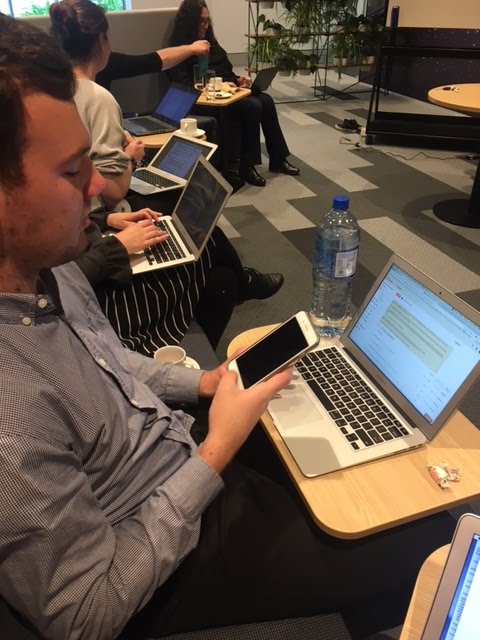
Developing in Digital Worlds with Cynthia Greenleaf!!

Setting Discussion Norms 

  • It is important to set discussion norms in your classroom. "How we support each other in the classroom" - Can co-construct with your class.
  • Changeable 
  • Can be added to over time. 
Those who do the reading, thinking and talking are the ones doing the learning. 


How do we get a dialogic argumentation? 
Allow students to engaged in texts that pose different ideas. Allow students to engage in discussions where they have to justify their ideas.


Slip or Trip Example:

Discuss in small groups.
Find evidence explain its importance.

Skill: Make a claim, can find evidence, can't link the two with critically reasoning.

Go Meta! - Metacognitive, go meta with our relationships

Refine our norm! - What supports collaborative argumentation? (Positive rules)

Think about online discussions? Students are in a world where they can talk online in many different forums. Are we allowing students to have opportunities to negotiate social norms?

Online forums create distances between those interacting and talking - we are unable to read facial cues and gestures.

https://www.readingapprenticeship.org/


Next Steps for myself:
What about another point of view? How could you use the point to support your argument?

Selective Bias -
Argumentation writing- Show all perspectives, weigh them up and then come to a conclusion.

Getting students to be comfortable with the 'unsolved' with wonderings. No right or wrong answer

Provocation/ Picture Idea!

Once a week where students have to respond and contest their beliefs. Could upload to the class blog. Students could write their response??- Do with Sally!

Could review their conversations 'go meta' or 'analyze evidence'.


Tuesday, 4 September 2018

MIT Tool Development

Today has been a day of reviewing and developing my tool. This has been one of the most successful days working on my tool. As I progressed it made more and more sense and came together.

I have extended the content from only having board examples and question prompts. Below is my website layout. The website is yet to go live as I want to get a few more videos up.


Homepage:
The What? The why? The how? and about me.
I am going to add pictures of students to this page as it is not very visually appealing.


Page 2 
The Boards- Examples of boards with links to make a copy. At the bottom of this page is a google form that other teachers can submit their boards onto the site. 


Page 3:  Question Prompt- This page has question prompts that link to videos of the students using them. ( Still, need to get that video footage). Michelle ( My principal suggested a link so that teachers can access these prompts to save onto their drive or print) 


Page 4: Example of what argumentation looks like in my classroom. I have One example but will be filming more as part of my class on air that I can use too. 


Page 5: Students Blog Example- This will have links to students blogs showing their argumentation boards. A way for teachers to see the ways my students have shared their learning and thinking. 


Page 6: Creating your own board. This page has links to website and search engines that I use to find my text content. It also has a checklist with ideas to think about when designing your own boards. 


Monday, 20 August 2018

MIT - Clarelle's Blog Post on my Tool

Below is Clarelle's Blog post about my tool, see her Blog Post here.


Today the MIT teachers had another wonderful day at KPMG. As part of our day we explored our inquiry projects and talked about our next steps for amplifying these inquiries.

Rebecca's inquiry focuses on increasing critical literacy in her classroom through argumentation. She has also been using a range of prompts to support critical and inclusive discussion in her classroom.  

Her tool focuses on sharing the prompts and the discussion boards that she has used to provoke critical thinking.

Some of the collective feedback for Rebecca was to provide more description of how teachers can effectively engage students in using the discussion boards. We also suggested that she adding an about this tool page to provide more support for the users of her resource.


MIT Tool Feedback - Zac


Movie Making

Zac presented his Tool on our MIT day out at KPMG. Zac's tool is an interactive website that is all about 'movie making' as a means to improve student achievement in writing.  Zacs site has four main sections; How to videos, Film techniques, Teaching strategies, Graphics & Images. Each section has examples and videos made by the students in his class. Zac's site has a great flow- making it easy for teachers and students to use.

The tool is a one-stop site for everything movie making- from storyboarding, to editing using iMovie. It is a great place to learn more or to start out!!

Next Steps:
- State on the site that the students have created the videos.
- Give more information on how he manages the students and what he does as the teacher when they are filming.


MIT KPMG Session 3

KPMG Session Three

Feedback/ Next Steps:

-Includes mini lesson Plans with each argumentation board
- 'About this site' -blurb + short video. ( The why? Whats the deal with argumentation boards and critical literacy?)
-Site flow: The site will be in three parts.
Part One- Argumentation Boards + teacher notes.
Part Two - Prompts - Each question prompt will have a link with a short video showing how students use that particular prompt.

https://developingindigitalworlds.blogs.auckland.ac.nz/ 


Thursday, 16 August 2018

MIT Tool

As the end of the year creeps up, I have been thinking about my 'Tool' for my MIT Inquiry. This year I have explored multiple options and ideas- each with its own advantages and disadvantages. I have to constantly take myself back to my problem; Student achievement in literacy. As my students have begun making accelerated progress I have reflected on the what? and how? What has made this shift and how has it helped them. I have changed many aspects of my literacy programme this year to suit the needs of my learners. The biggest change has been the use of argumentation boards to prompt critical literacy, critical reasoning and evaluating texts at a deeper level, and also my pedagogy has developed through my developing digital worlds PD.

Tool: 
My tool idea has been to create a resource bank of Argumentation Boards- to allow other teachers to use the resources that are already made. Sometimes the problem for teachers to give it a go is they don't know where to start. So I am wanting to have a place where the can view and copy our argumentation boards. 

Hurdles: 
- How will the site update? How can I ensure that it is added too?
- How can I ask other teachers for their resources to add to it?
- Should I include reflections on each argumentation board... What worked? 
- Could I add question cards as a resource? 


Friday, 10 August 2018

Science PD Term 3 and Science Observation

Staff Meeting Points:

  • Use interest/ engagement to strengthen and go deeper.
  • Changing their identity so they become competent.
  • CrossCuts make the knowledge coherent.
We talked about how Identity, Interest, Contextual strands, crosscutting concepts, and science and engineering practices integrate to build strong scientific knowledge and lessons. 

I talked about how my squid dissection lesson focused on the living world. We carried out an investigation and collected data using our five senses. We used the crosscutting concept of function and systems to discuss how the squid's internal systems are suited for is habitat. 


This week Susan came into our classes to model more science lessons. She did a water-based science experience, a static experience and then with my class she did  "Can we heat water in a paper cup".

Introduction: 
Susan discussed the science field we would be working in; chemistry and physics.  (Using this vocabulary from a young age was important to help students make connections within science). She started with a story about the droughts in Australia. (Vocabulary: Agriculture, emergency, water needed for life, livestock, problem)

Discussion of Apparatus: ( Talked about the structure and function of each tool that we would be using, students drew each tool and labeled it  )

  • Thermometer 
  • Meth Burner 
  • Gauze Mat 
  • Tri-pod 
  • Beaker 

- Students drew a diagram that represented the creation of heat. ( Discussed this is a symbolic representation for heat- it is standardized)

Experiment: 
Students set up their heat source. They had a beaker of ice cold water- they took the starting temperature. They then poured water into a small paper cup (Muffin case). They lit the meth burner alight and then watched the water in the paper cup start to steam and bubble. They retook the temperature and recorded it.

Reflection: 
PMI - What happened? Questions? Thoughts?
Recap of key vocab.

So what ? 


For me, the biggest take away was how Susan constantly stated and went back to the key vocabulary. At the end of the lesson, the students were using that vocabulary to describe different parts of the experience. Instead of saying 'I used the pointy thing' They were saying ' I used the thermometer to measure the temperature of the water'. This is the most important aspect of the lesson and I think would extend my students thinking and how they discuss science.