Pages

Showing posts with label inquiry2018. Show all posts

Friday, 15 June 2018

Developing Digital Worlds Session Two

Today we had our second session Developing Digital Worlds Session with Jacinta. Below are the main ideas that I took away:

1.  The importance of 'Activating Prior Knowledge'. We discussed how sometimes this is not given enough time or importance. Using what students already know as building blocks is a critical tool.

2. After having a go with an augmentation board. Evaluate what texts the students were on the most, using the screen time section on teacher dashboard. This will give me a good idea of what text types students are using/ compare to the ideas they are coming up with.

3. Checking that sources are credible and reliable. This is something we have been doing in writing when note-taking. We have been giving a note a tick when we see it in another text. This helps us see what information is reliable as we have seen it in multiple texts.

4. Text sets- Possible the most important aspect of a successful argumentation board. Using a range of texts that offer alternative views.


"How many texts will support the principles of argumentation (below) in your subject area? Rationale?
To be able to substantiate, and evaluate, the integration of claims, reasoning and evidence to support rational decision making or belief, while also giving appropriate attention to counterclaims, reasoning and evidence that informs a critically reasoned conclusion."

Prompts for Attending to Overlooked Evidence:

  • What do you make of this (reference data/information)?

  • What else do we need to take into account?

  • Who has another observation that can help us look at the whole picture?

  • Is there anything we’re missing?

  • Who has a different idea?

I have filmed two class on air episodes using a critical literacy approach with an argumentation board. Click here to see Lesson 6. My next lesson will demonstrate the new skills I have taken from my session with Jacinta; Using alternative texts, focus on APK, prompting questions and less teacher talking, more students thinking! 
.

Wednesday, 16 May 2018

UDL

How to design learning for all students 

UDL 

Engagement- Provide an environment that is supportive of all students 
Representation- How we present the information in different ways 
Action and Expression- Learn, create, share. 

Technology- Google tools/ site- 
Instructions not too much on one slide
Adding audio
Using videos
Rewindable learning. 
Visual prompts 

Differentiated thinking 
-Retrofit 
-Fix the students 
-differentiation 
-adaption 

UDL thinking: 
Design from the edges 
Being inclusive 
Giving them options of tasks to choose from 

7 Principles of Learning 
The principles are identified as:
  1. Learners at the center
  2. The social nature of learning
  3. Emotions are integral to learning
  4. Recognising individual differences
  5. Stretching all students
  6. Assessment for learning
  7. Building horizontal connections 


So what? 

After the course, I thought that a lot of my practice does have the UDL principles underpinning it. The course allowed me to see that a lot of what myself and sally are already doing is UDL and is allowing all students to be included. One take away from the course was that I should plan from the edges of my class and give more options or avenues for students to take when learning. An inquiry learning focus helps students get more choices and allows me as the teacher to offer many different ways to complete the inquiry. At times I find it easier to differentiate the learning to meet the needs of my students but this has its implications. Next week I am going to plan with a UDL hat on. 

Tuesday, 15 May 2018

Analysing Target Students Data

I have got three target students that I am focusing on for my MIT inquiry and my TAI ( within my school). My inquiry is around how I can increase critical thinking in literacy. I completed an asttle Reading test on my class to look at the gaps in their learning. 


The gaps for target students: 
  • Find, select and retrieve information
  • Make inferences 
  • Respond using understandings and information 
  • Skim and Scan for information 
  • Knowledge of Vocabulary 
  • Identification and understanding of main ideas. 
So what? What is going to help?


I have created a 'bookmark' to support a Critical Reading approach for the students to use while Reading. The bookmark provides a thinking framework for the students. With a focus on predicting, self-monitoring, questioning and summarising. This reciprocal reading/ critical reading approach will hopefully provide students with a supportive framework. Then I can build on these important strategies in my reading sessions. The next few weeks I will ensure they know how to use the framework effectively and are discussing their ideas within their groups. 

What knowledge do I need to know? 

  • The links between Oral language and Reading. - Will find readings to support my learning. 
  • Using Universal Design for Learning - This could help with my Reading Programme (I am going to a UDL course today). 


Tuesday, 17 April 2018

M.I.T Moonshot

This week I have been thinking about my moonshot inquiry. During my last KPMG session, I changed my focus from STEM to Reading. This was because my student's achievement was low in ALL academic areas- My group and I discussed that If they could read at a higher level this would benefit other curriculum areas. 

My new inquiry is 'How can I increase critical thinking in Reading?' 

The tool I want to look into creating would be a framework or a rubric that would help my year 5-6 students think critically about what they are reading. 

What I want to look into to help me with this? 
- Blooms taxonomy 
- Comprehension strategies (Effective literacy practices) 
- Sheena Cameron strategies and framework. 

Connecting my Inquiry to the design thinking process 
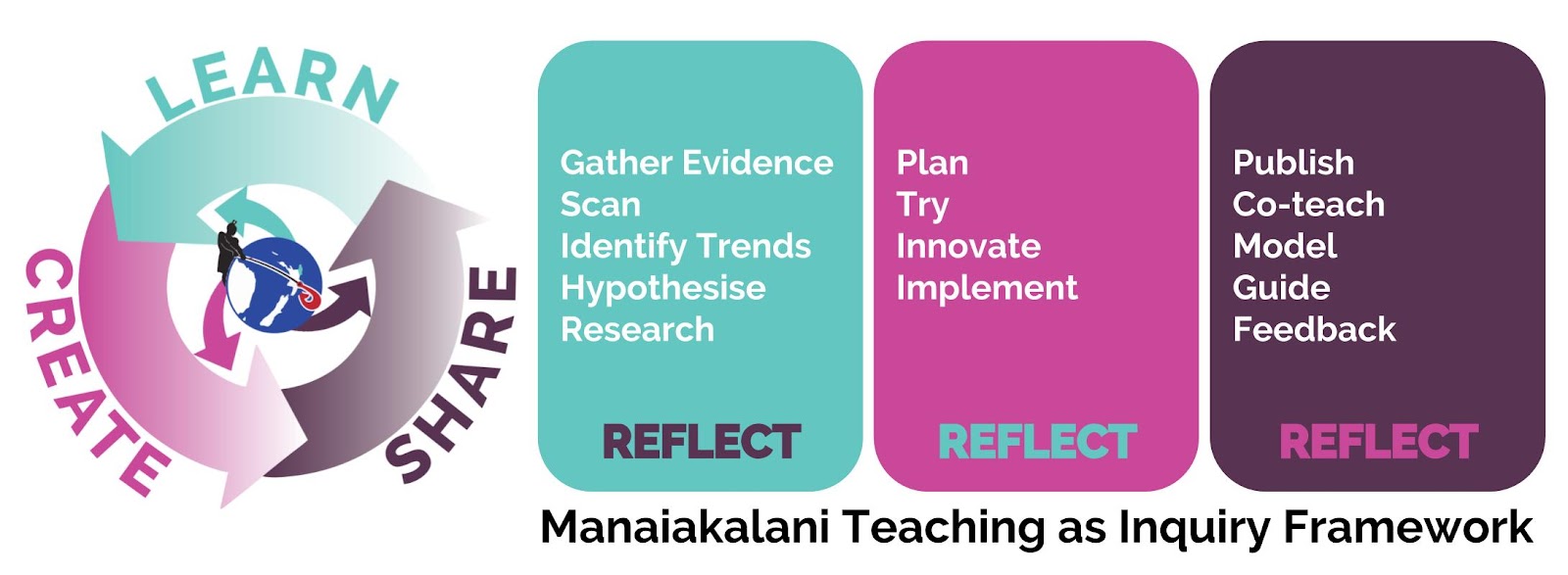
After looking at Rebecca Jenson's Manaiakalani Inquiry slide I can see that I am planning, trying and innovating. The design thinking framework is helping me create prototypes to support my problem. 


I am in the process of organizing an observation of another Year 5-6 class at a Manaiakalani School. This will help me think about the level of year 5-6 and compare it to what my students are doing.- this will furthermore support my inquiry. 

Monday, 16 April 2018

Class On Air Term 1 Reflection

This term I have been working with Manaiakalani and Google taking part in Manaiakalani google class on air. The experience has been allowed me to reflect on my practice and notice what I am actually doing when I am teaching. I think how we think a lesson goes to how it actually goes watching it back differs. I learned that at times I miss key teaching moments as I am distracted by other students - Working in smaller groups helps minimize this as it is hard to know what 28 students are all thinking and what they are gaining from the lesson. My lessons have had a science/ technology type focus. Science is one of my weaker curriculum areas as I don't have much experience teaching it. This term we have been given P.D by Susan heeps, this has helped me immensely. Next term I am going to focus on Literacy and reading. My inquiry this year is how can I increase critical thinking in Reading- so the knowledge and skills that I develop in my inquiry can add to my class on air episodes. 

So what next term?

- Camera angles (Light reflection- blackout class windows to ensure that the quality of the footage is easy to see) 
- Sound- Use the plugin mic and my phone ( ensure the phone is facing the speaker) 
- Create: What are students going to create next term to demonstrate their understanding and learning?
- Will observe at another school. See what other year 5-6 students are doing. 
- How are we using the digital tools to enhance our learning ( Modelling book, working collaboratively on docs) 
-  Look at Bloom's taxonomy, Reading comprehensions.
- Smaller groups (Science was a whole class and was great when starting out my science journey but now I need to target specific needs). 
- Key learning and teaching focus- develop critical thinking.
- Making cross the curriculum connections. 


Tuesday, 10 April 2018

Science PD

Susan discussed the importance of planned talk. It needs to be specific to be effective. 
Need the talk to drive the learning as you don't want the kids to just be doing an activity (which is what I think is happening in my class currently). 

Points for Reading as a Staff: 
Accountable talk - Question Cards- (Getting more Student to Student talk) 

Managing Talk through grouping- Mixed ability grouping is the most effective, can group students through interests of languages. (Some need for ability grouping) 

Managing Time- Show them a clock, how did we tell time in the past?

Cultural Diversity and managing Linguistics-  Adaptability of learners (Example; text messages being restrictive originally- students created a 'txt' language to fit more characters into their text messages) 

Setting Clear Expectations- Self-check/ 

Managing to speak, listening, writing, reading- Oral language is KEY to critical thinking. Explicitly showing them 'how' to talk. 

Knowing your learners- How important this is.


Science Task:

Susan taught us how to get our students to think critically and ask more questions during science sessions. We looked at discussion questions. We each choose two and then completed the learning task with that question in mind. This was helpful as it focused our thinking and we could think deeper about our question.

Next steps:
I'm going to print out question cards and use them in my next science lesson. 


Tuesday, 13 March 2018

Effective ways to teach reading

After analyzing our Reading comprehension data from the start of the year; many students in my class were achieving at a low level. We talked about them maybe skipping through the test or not understanding certian questions. ( As when I am working with them in class they are thinking at a higher level) The data has made me re-evaluate my reading planning. It is my first year teaching year 5-6 so I am still 'finding my feet'. I have recently looked at blooms taxonomy and have started to incorporate that into my planning. BUT I still want to know what a great reading lesson looks like at a year 5-6 level. 

This sits in well with my Inquiry which has a strong focus to develop critical thinking. 

Something I tried today was evaluating a poem. Many of my students scored low when working with a poem in the test ( This indicated to me that maybe they aren't being exposed to that type of text as often)  We read a poem together and then talked about the different features within the poem and figurative language. I used teacher talk aloud to help the students understand the text at a deeper level. This was a great first step and I am wanting to do this every week with a follow up that helps the students consolidate any new learning. I am hoping that this will increase their vocabulary knowledge and their understandings about poems/ the choices writers make to convey meaning or ideas. 

Readings 

Readings: Effective Literacy Practice Year 5-8 
Explicit teaching of the strategy  teacher think aloud) 
Scaffolding the students to use the strategy 
Encourage students to articulate how they are using that strategy 
Encourage them to apply this new strategy to their reading. 

"thoughtful, active, proficient readers are metacognitive; they think about their own reading during reading" 

Comprehension Strategies - What can teachers do to support learners?

Making connections - What do you already know about that? What do you remember about persuasive texts? 

Forming and testing hypotheses about texts - ( Predicting ) - I noticed that the author used lots of adjectives to imply the character is said, do you think the author is suggesting a gloomy outcome for that character?

Asking Questions- We can see the author has a strong view about this topic. I wonder how he might try to affect our thinking as we read. 

Inferring- find the words that suggest that?

Identifying the writer's purpose and point of view-

Main idea - I think the text is giving us the message that.... because... 

Summarising- Does your summary give you a clear overview of the text? 


Thursday, 1 March 2018

School Inquiry

Using STEM to increase engagement, critically thinking and problem solving.


Our school focus this year is 'communicating in Science'. During our inquiry meeting, we discussed target students we had and the data we had collected. Overall we talked about how we all need to collect more data so that our hunches are supported by accurate data. I have decided that I am going to use my MIT inquiry as my school inquiry too. Michelle talked about this being most effective and will allow for a very deep inquiry. I thought about different ways that I could increase engagment and increase critically thinking. We talked about Universal design for learning Vs Differentiated learning. 


What do I need to do now?

My knowledge of STEM needs to be unskilled.
How I can integrate STEM throughout the day?
Rich tasks- STEM- prompts problem-solving 


Wednesday, 24 January 2018

Science PD (Stem) with Susan Heeps

Science PD 

Our first session for our science PD was extremely successful. These are my notes below with some big ideas that I will be taking into my classroom. It was a huge benefit to have science experiments modeled to use which helped me understand how they would work in my classroom. 

STEM 
(Science, technology -tools,  engineering, mathematics) 
Science - Natural/ Physical World
Engineer - Made world


Ice Ice Baby Experiment


The ice experiment involved us numbering tasks in any order. Susan then rolled a dice and we did that number for 30seconds with a piece of ice. The winning group was the one whos ice completely melted first. After doing the experience, I immediately wondered how the other group has won.
Thoughts:

They are naturally thinking which action will produce the most amount of change. 
Science is about change
Focus on science - not we are not going to write about this- think about scientists recording/ analyzing, gathering data. 
Science thinking and observing (5 sense need to be used) 
Use vocab after the first experiment
Positioning - Side view/ bird's eye view
"we are doing it again in intervals of 30 seconds"
"which one are you going to repeat"?

Ant learning 
Draw an ant- what do you think it looks like?
Label your ant
Collaborate- Share with others contribute to the group 
Explore the unknown - Look at expert pictures 
What do you notice?
Compare and contrast
Do you need to change your diagram? 
Video of Ants counting - Questions? 
Revisit video / Review / Reflect (Do this with all work) 


Unpack videos and enrich the student's vocabulary. 
How scientists work. - Many different kinds of scientist 

Connecting the Curriculum
Confident 
Connected 
Actively involved
Lifelong learners 


Key ideas: 
Doing- then the big ideas. 
Get the meaning out of doing.
Understanding we are learners 
This year I am going to provide a library of experiments
Science- A way of knowing - Explanations generated based on evidence that can change over time. My job is driving their awe and wonder.
Look into: https://chipbruce.files.wordpress.com/2008/11/butterflies.pdf  


I will be doing the ice experiment with my class and seeing what sort of questions arise. I am also wanting to think how I can technology to enhance this lesson..